
Food systems are complex, interconnected webs that touch every aspect of our lives, from the food on our plates to the health of our planet and the prosperity of our communities.
Transforming these systems to be sustainable, equitable, and resilient is a monumental task, and evaluating the success of such transformations requires a sophisticated approach. The Independent Evaluation Office (IEO) of the Global Environment Facility (GEF) recently evaluated the GEF Food Systems Programs (GEF IEO, 2025). This blog post delves into what works, the key challenges, and the desired changes for a truly transformative impact on our environment, climate, and society.
The GEF Vision for Sustainable, Equitable, and Resilient Food Systems
Over the last decade, the GEF has emphasized the need to transform global food systems through a comprehensive strategy addressing land, resources, and supply chains. Since 2014, dedicated programs have been designed to be:
- Environmentally Sustainable: Reduce impacts on land, biodiversity, water, and emissions by advancing climate-smart agriculture and resource conservation.
- Climate Resilient: Equip food systems and communities to handle climate change through adaptive practices and infrastructure.
- Socially Equitable and Inclusive: Ensure food security, decrease inequality, empower marginalized groups, and promote fair employment.
- Economically Viable: Support sustainable livelihoods and market access for producers throughout the value chain.


Embracing a Systems Approach for Tangible Change
Effective food system interventions are not isolated projects but rather interconnected initiatives that acknowledge the complexity of the targeted system. To assess whether GEF uses a comprehensive systems approach to enhance the transformation potential of its food systems interventions we developed a conceptual framework to analyze food systems elements and dynamics, including drivers, root causes, value chains, and outcomes. This framework supported a systematic review of relevant programs, focusing on the advantages of applying food systems thinking in four main areas (see figure below).
Food Systems Transformation
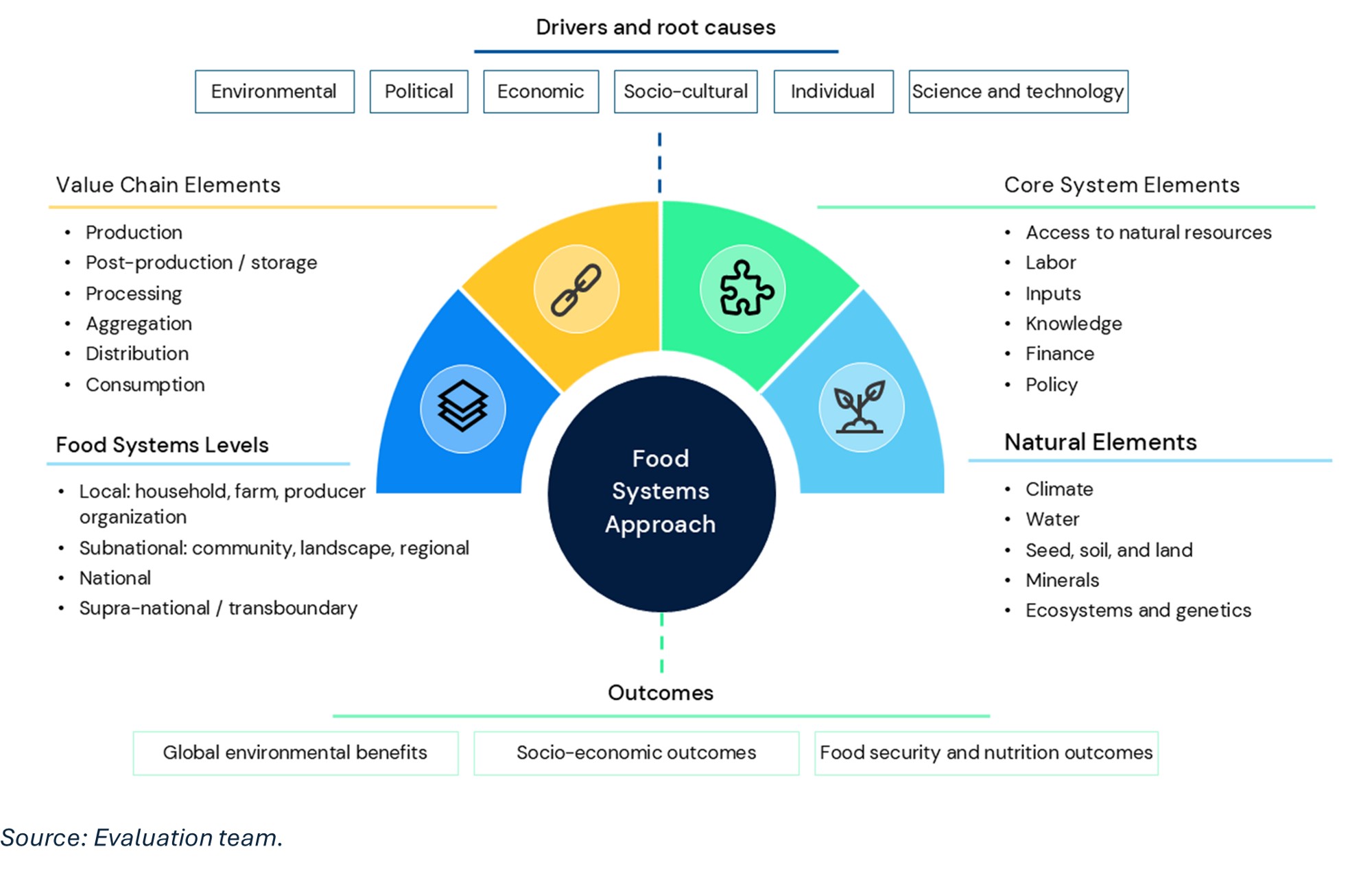
Source: Evaluation team.
The application of this framework to the analysis of GEF food systems interventions enabled us to identify crucial elements for generating meaningful change:
i. Holistic Design and Integrated Approaches: Effective programs target key leverage points to address food system challenges beyond production, covering value chains, policy, governance, and demand. Integrating environmental sustainability with socio-economic benefits at various scales strengthens these approaches. For example, GEF's Good Growth Partnership uses a commodity supply chain focus for beef, soy, and palm oil across four countries, combining landscape management and value chain considerations for a more integrated model.
ii. Multi-Stakeholder Engagement and Governance: Effective transformation of food systems relies on broad participation—from farmers to governments, businesses, and civil society. The GEF’s experience highlights that strong multi-stakeholder platforms (MSPs) foster necessary dialogue, coordination, and shared responsibility. Projects with clear governance and sustainability plans are more likely to drive lasting change. For instance, the Food Systems, Land Use, and Restoration project in Tanzania uses MSPs to unify diverse interests for sustainable land and water management.
iii. Learning and Adaptive Management: The food system landscape changes rapidly due to shifting policies, climate change, and global events. Programmes that adapt based on new evidence remain effective. The GEF’s progress over the last ten years reflects ongoing integration of lessons learned, with adaptive management and strong knowledge systems supporting continuous improvement.
iv. Address Root Causes and Systemic Issues: Meaningful change comes from tackling the underlying drivers of food system challenges, not just their symptoms. Projects that target policy, political, and cultural factors—and design interventions for these systemic problems—can have a lasting impact. The Food Systems Integrated Program advances this with its focus on policy coherence and supportive regulations.
Navigating the Complexities of Transformation
Despite the achievements and promising approaches, significant challenges hinder the pace and scale of GEF supported food system transformation:
i. Limited Focus on Post-Production and Demand-Side Elements:
Many projects remain heavily concentrated on the production side of the value chain, with less attention paid to crucial downstream segments like processing, distribution, consumption, food loss and waste, and nutrition. This linear, production-centric bias limits the transformational potential of interventions.
ii. Underestimating Political Economy and Socio-Cultural Drivers:
Projects often struggle to adequately identify and address political economy dynamics, such as resistance from vested interests, power asymmetries, and misaligned incentives. Similarly, socio-cultural dynamics that influence behavior and consumption patterns are frequently overlooked, hindering the adoption of sustainable practices.
iii. Fragmented Implementation and Coordination Gaps:
The complexity of multi-stakeholder engagement and coordination across different government agencies, administrative levels, and implementing partners often leads to inefficiencies, delays, and a lack of integrated action. This is particularly evident in the challenges of aligning national policies with sub-national implementation.

iv. Insufficient Attention to Gender and Social Inclusion:
While many projects include gender-responsive measures, there is a noticeable absence of strategies to address underlying gender dynamics, shift power relations, or create opportunities for women to challenge traditional roles.
v. Challenges in Measuring Transformational Change:
Traditional monitoring frameworks often fall short of capturing the complex, multi-dimensional nature of transformation. More sophisticated and adaptive metrics are needed to meaningfully track progress along transformation pathways.
vi. Country Docking and Knowledge Uptake:
Ensuring that global knowledge and technical support are effectively tailored to country needs and readily absorbed by child projects remains a persistent challenge. Misaligned timing, top-down approaches, and insufficient resources for localized support hinder effective knowledge uptake.
Moving Forward: Lessons for Future Action
By embracing a systems thinking approach, focusing on the interconnectedness of elements, and acknowledging the complexities of implementation, we can better understand what works and where the persistent challenges lie when transforming food systems.
The desired changes for a sustainable, equitable, and resilient food future are clear, but achieving them requires a sustained commitment to integrated design, robust stakeholder engagement, adaptive management, and a willingness to address deep-rooted political, social, and economic barriers.
The GEF journey offers a roadmap for future interventions, guiding us towards a more impactful and transformative approach to shaping our food systems for the benefit of both people and the planet.


Disclaimer: The blog presents the views of the authors and does not necessarily reflect the official position of the GEF IEO.