
Evaluation Findings for Climate Action
Independent evaluation evidence to inform COP31 and beyond
As the global community prepares for COP31 in Antalya, Türkiye, the Global Environment Facility Independent Evaluation Office (GEF IEO) is contributing independent evidence to inform more effective, integrated, and sustainable climate action.
As one of the early partners of Evidence for Climate Action (E4CA), the GEF IEO is helping strengthen the role of evaluation in global climate discussions.
This special edition brings together findings from our recent evaluations of sustainable cities, nature-based solutions, climate information and early warning systems, and climate adaptation, alongside insights from the Eighth Comprehensive Evaluation of the GEF (OPS8).
Together, these evaluations offer important lessons on what works, where challenges persist, and how climate investments can deliver lasting environmental and development benefits.
Explore the evidence and join us at COP31 as we work with partners to advance evidence-informed climate action.
Building Sustainable Cities: Why Integration Matters for Climate Action

$480M
GEF financing
$5.3B+
GEF Co-financing
The evaluation examines the benefits and implementation challenges of integrated urban approaches. It highlights the importance of coordinating across sectors and levels of government, strengthening local ownership, and connecting urban planning with sustainable financing. These are important considerations for cities seeking to deliver lasting climate and environmental benefits.
Nature-based Solutions: Delivering Climate, Biodiversity, and Community Benefits

933
Projects reviewed
87%
Satisfactory outcomes
80%
Targets achieved
GEF-supported nature-based solutions demonstrate how ecosystem restoration and sustainable natural resource management can address interconnected environmental challenges. Stronger results emerge when interventions combine restoration with community co-management, secure continued financing, and become embedded in national strategies. Persistent gaps in policy alignment, financing, and scaling remain important challenges.
From Early Warnings to Early Action: Closing the Last-Mile Gap

The evaluation finds that GEF investments have strengthened forecasting capabilities and institutional capacity, but translating climate information into timely, effective action remains a challenge, particularly for vulnerable and remote communities.
Projects performed better when early warning systems were integrated into disaster management plans, connected forecasts with preparedness measures, and used accessible technologies. Sustaining these systems requires community engagement, institutional coordination, and long-term financing.
Key message: Early warning systems are only effective when information reaches the people who need it and enables them to act.
OPS8: What the Evidence Tells Us About Climate Action
From Project Performance to Transformational Climate Action
OPS8 provides a broader perspective on how GEF investments can achieve environmental results at scale.
Its climate-related evidence highlights several important findings:
Integrated programming: Climate mitigation benefits are increasingly pursued alongside biodiversity conservation, land management, and other environmental objectives.
Mitigation opportunities: GEF-8 integrated programs emphasize agriculture, forestry, and other land use (AFOLU), with comparatively limited attention to fossil fuel reduction. Sustainable Cities stands out as a program focused primarily on non-AFOLU mitigation.
Multiple development benefits: Completed climate mitigation projects have contributed to goals involving energy access, sustainable cities, responsible production, and other development priorities.
Transformation and sustainability: Stronger country ownership, innovative financing, private sector engagement, and pathways to scaling are essential for lasting results.
Beyond Project Completion: Sustaining Climate Adaptation Results

180
Completed projects
83%
Satisfactory outcomes
61%
Likely sustainable
The LDCF/SCCF Annual Evaluation Report 2026 finds that adaptation projects achieve strong outcomes, but sustaining their benefits remains a challenge. While 83% of completed projects achieved satisfactory outcomes, only 61% were rated likely to sustain benefits after closure.
The findings underscore the need to integrate sustainability planning early, strengthen financial mobilization, and create conditions for adaptation investments to scale beyond individual projects.
GEF IEO at COP31
- Monday, 02 November 2026
- Tuesday, 03 November 2026
- Thursday, 12 November 2026
- Friday, 13 November 2026
- Saturday, 14 November 2026
Opening Event: E4CA at COP 31
Time: 09:00 – 10:00 EST
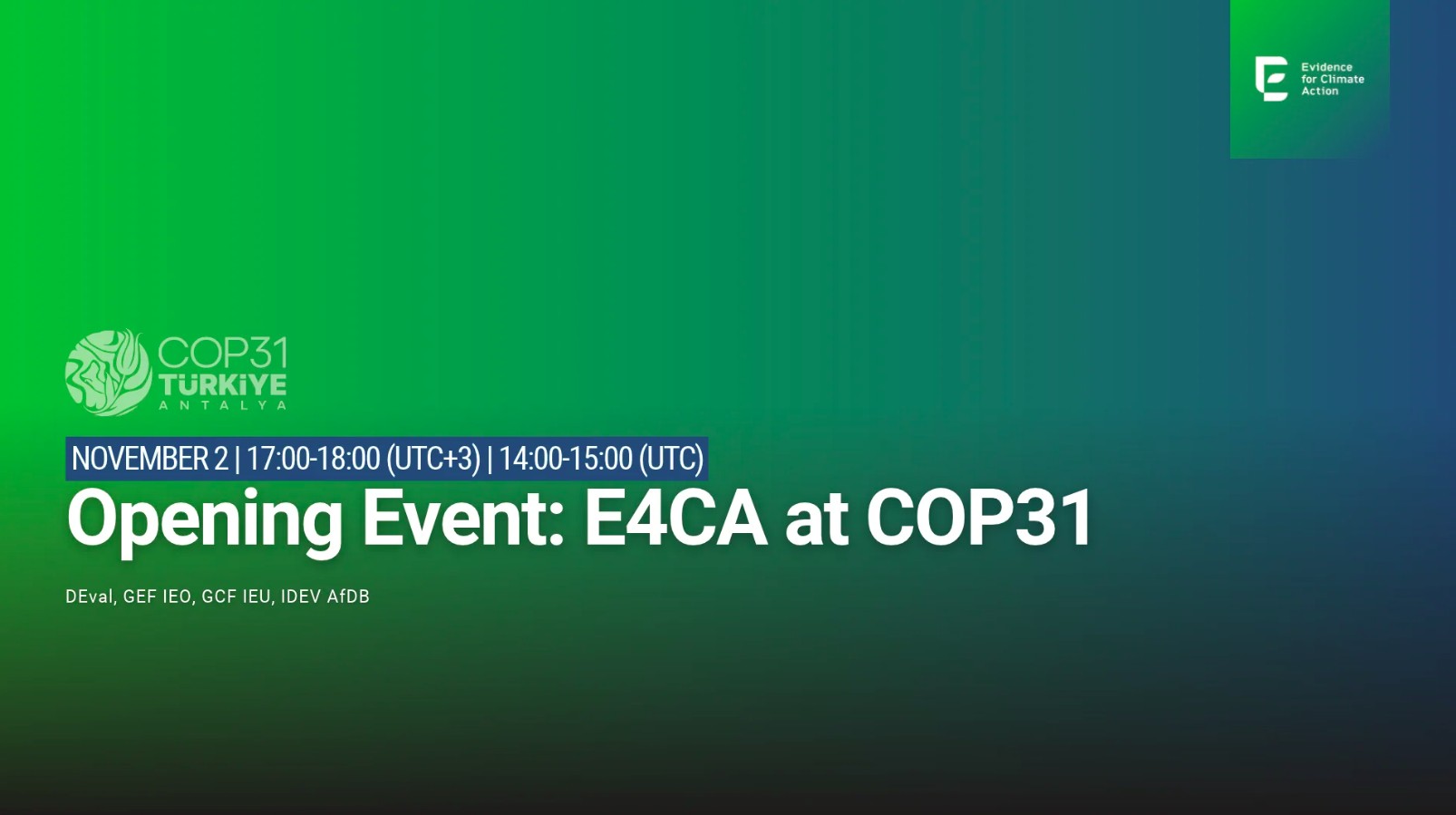
Participating Organizations: DEval, Global Environment Facility, Green Climate Fund, Independent Development Evaluation, AfDB, Rockefeller Foundation
Speakers: Sven Harten, Jörg Faust, Geeta Batra, Karen Rot-Münstermann, Oscar García, Shawna Hoffman
About this section: Join us for the official opening of the Evidence for Climate Action (E4CA) Pavilion at COP31 in Antalya — a dedicated space at a COP for independent evaluative evidence on climate action implementation.
As the Presidency's agenda turns from ambition to acceleration, a critical question remains: how do we know what actually works? The E4CA Pavilion exists to answer that question, bringing together the world's climate evaluators and researchers to ensure that decisions on finance, mitigation, adaptation, and loss and damage are grounded in rigorous, independent evidence.
This opening event will introduce the purpose and vision behind the Pavilion and the broader E4CA initiative — a year-round platform connecting evaluation, research, and policy across the climate community.
The conversation will bring together senior representatives from across the E4CA coalition, reflecting the breadth of institutions that have joined forces behind this initiative. In a moderated conversation, they will discuss why evidence must sit at the heart of the implementation agenda, what opportunities and gaps exist, and what the Pavilion aims to achieve over the course of COP31 and beyond.
Come learn what the E4CA Pavilion stands for, meet the coalition driving it forward, and discover how independent evidence can help turn commitments into outcomes.
Embedding Evidence in the New Climate Finance Landscape: Evaluation, Efficiency and Climate Finance Decision-Making
Time: 09:00 – 10:00 EST
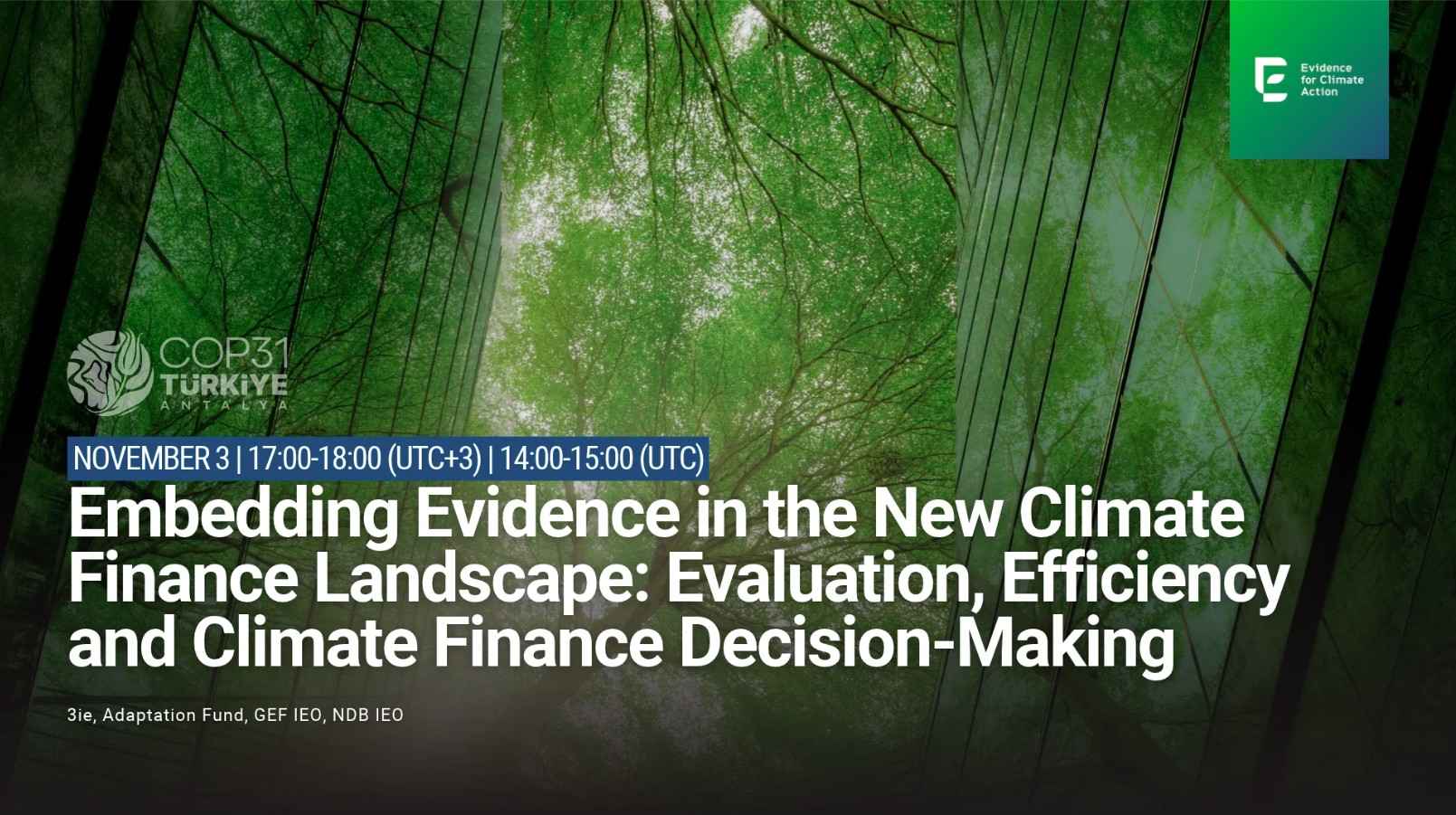
Participating Organizations: International Initiative for Impact Evaluation - 3ie, Adaptation Fund, New Development Bank, Global Environment Facility Independent Evaluation Office
Speakers: Constanza Parrao, Neha Sharma, Manas Puri, Marie Gaarder, Geeta Batra
About this session: Public climate finance has grown roughly sevenfold in fifteen years, from around USD 20 billion in 2010 to over USD 136 billion in 2025 (OECD, 2026), yet the evaluative evidence base has not kept pace.
Analysis by the Center for Global Development (Cichocka and Mitchell, 2024) finds that less than one rigorous evaluation exists per USD billion of official development assistance spent on climate mitigation, and roughly 2.5 per USD billion spent on adaptation, compared with 136 evaluations per USD billion in nutrition.
This session asks a purposely practical question: given that climate finance is stalling, at least in terms of finance flowing from traditional Annex I parties to developing countries, what would it take to close this gap at the speed that climate emergencies are moving?
In this policy dialogue, panelists, spanning bilateral and multilateral funds, private funders, and evidence specialists, will debate concrete, contestable propositions such as whether investment committees within climate funds (the Adaptation Fund, the Green Climate Fund, the Global Environment Facility) should require a stated evidence position at the concept-note stage rather than at final approval; whether minimum evaluation standards should be developed, and who would be best placed to coordinate that effort; whether the inconsistent application of Rio markers across bilateral and multilateral taxonomies is primarily a measurement problem or an incentive problem; and whether, and how, project cycles can generate credible evidence for interventions whose payoffs unfold over decades.
The panel will draw on, and test against, the CGD ‘spending blind’ analysis as its evidentiary anchor, using it to surface where the diagnosis is contested among funders and evaluators themselves. The discussion will move from diagnosis to solutions and decision points: where in a funding cycle would evidence need to arrive, in what form, and delivered by whom, for it to change what gets approved. In turn, how evidence generation can accelerate and innovate to support decision-making more responsively. The session will close with panelists reflecting on specific, checkable actions that organizations and the sector as a whole can take to narrow this evidence-to-funding gap.
Urban Planning and Governance
Time: 02:00 – 03:00 EST

Participating Organizations: Environmental Protection Agency of Liberia, ENEA, The Climate Institute, Ahmedabad University, Global Environment Facility
Speakers: Arthur R.M. Becker, Paola Clerici Maestosi, Shaurya Patel, Minal Pathak, Nupur Joshi, Neeraj Kumar Negi
About the GEF session "From Evidence to Action: Lessons from an Urban Sustainability Program Evaluation": The Sustainable Cities Program (SCP) of the Global Environment Facility supports integrated urban sustainability across more than 90 cities in 33 countries, with US$480 million in GEF grants, cumulatively.
Its two-tier architecture combines a Global Platform for knowledge exchange with national policy engagement and city-level investments in recipient countries.
The evaluation finds that SCP has catalyzed policy change in several countries, mobilized substantial resources, and generated verified environmental gains through nature-based solutions, GHG emissions abatement, climate resilience, and biodiversity conservation.
Its has also supported knowledge exchange and partner convening. The evaluation finds that two structural gaps constrain longer-term impact. First, integrated planning and pilot investments often proceed on parallel tracks: plans are not consistently linked to bankable investment pipelines, while successful pilots frequently reach project completion without adequate arrangements for replication and scale. Second, the Global Platform is insufficiently aligned with country project timelines and remains largely global in orientation, with limited localization. In response, the GEF management has committed to making investment readiness and pilot replication explicit expected outcomes in future programming and to better align Global Platform activities with country project timelines.
Is Climate Finance Delivering? Evidence on Performance, Efficiency and Mobilisation
Time: 03:30 – 04:30 EST

Participating Organizations: Global Environment Facility Independent Evaluation Office, DEval, Global Environment Facility
Speakers: Neeraj Kumar Negi, Magdalena Orth-Rempel, Jeehyun Yoon, Andreas Reumann
About the GEF session "Programmatic Climate Finance and Transaction Costs in SIDS": Climate finance increasingly uses programmatic approaches to reduce fragmentation, improve coordination, and give small states access to technical support they could not sustain alone.
Yet in countries with populations below 200,000 and thin public administrations, these approaches may impose coordination burdens that exceed absorptive capacity. This session examines that trade-off using an evaluation of three GEF programs and 19 child projects across 14 Pacific small island developing states, within a wider portfolio of 140 interventions totaling $528 million. The evaluation combined theories of change, quality-at-entry review, terminal evaluation evidence, project-cycle benchmarking, contribution analysis, field visits, and stakeholder interviews.
The evidence shows genuine additionality in cross-country coordination, knowledge transfer, use of expiring national allocations, and private capital mobilization.However, every child project was delayed, with delays accumulating across the project cycle. Start-up was a binding constraint: recruitment, project boards, procurement plans, and operating arrangements were often not ready at approval. Governments reported transaction costs above bilateral alternatives, reflecting multiple implementation layers and consultative demands on limited capacity. Limited regional expertise and high staff turnover also weakened sustainability; none of nine rated projects was assessed as likely sustainable.
The findings suggest that programmatic approaches should be used where coordination and knowledge benefits are essential, while readiness conditions and recipient administrative costs should be explicit in design.
For very small states, programmatic approaches create value only when their architecture reduces rather than transfers coordination burden.
Accessing, sustaining & scaling finance
Time: 06:00 – 07:00 EST

Participating Organizations: Global Environment Facility, Adaptation Fund, International Institute for Environment and Development
Speakers: Neeraj Kumar Negi, Geeta Batra, Vladislav Arnaudov, Susan Louise Legro, Mariana Vidal Merino, Pia Tricheli, Anaa Hassan
About the GEF session "Sustaining and Scaling Climate Adaptation: Evidence from Recent Evaluations": Cumulatively, the Global Environment Facility (GEF) has invested more than US$2.5 billion in climate change adaptation and resilience to reduce vulnerability and strengthen resilient institutions, ecosystems, infrastructure, and livelihoods.
Drawing on recent evaluations by the GEF Independent Evaluation Office (IEO), we identify what enables effective, sustainable, and scalable adaptation.
Evaluations show that adaptation results are more likely to be sustained when investments in resilient infrastructure, ecosystem-based approaches, climate information, and livelihoods are combined with institutional capacity, local ownership, policy integration, and financing for continuity.
Early warning systems illustrate this: equipment and information are insufficient unless warnings reach vulnerable users and are linked to actionable knowledge, preparedness, early-action protocols, and sustained operation and maintenance.
Nature-based solutions scale more successfully where country ownership, adaptive management, multistakeholder coordination, policy coherence, and credible financing pathways are present.
Results are weaker where capacity is overstretched, economic viability uncertain, financing short term, coordination fragmented, or design underestimates implementation challenges.
The evidence points to moving from delivering adaptation toward building resilient systems. Adaptation is more likely to endure and contribute to wider climate action when project functions are embedded in institutions, plans, budgets, and standards; risks are addressed at design; and monitoring captures outcomes, sustainability, and system change.
